


If you have been searching for how to increase swing speed in golf, you have probably read the usual advice: turn your hips faster, strengthen your core, improve your flexibility. Those things help at the margins. But the biggest swing speed gains most golfers will ever make do not come from mechanical adjustments or the gym. They come from training your nervous system. Here is what that means, why it works, and how to do it.
Why Most Approaches to Increasing Swing Speed Fall Short
Think about what a swing tip actually does. When your instructor tells you to clear your hips earlier or keep your trail elbow tucked, they are helping you transfer the speed you already have more efficiently into the golf ball. That is valuable. Better mechanics mean better contact, more consistent ball striking, and fewer shots lost to mishits.
But here is the thing: mechanics can only optimize what you already have. They cannot raise the ceiling on how fast you are capable of swinging.
The same is true for strength training. Building golf-specific strength is worthwhile, and stronger athletes tend to swing faster over time. But the translation from gym strength to clubhead speed is indirect and slow. You might spend six months in the weight room and add 2 mph to your driver.
There is a faster path, and it starts with understanding what is actually limiting your swing speed right now.
The Real Reason Your Swing Speed Has a Ceiling
Your central nervous system governs how fast your muscles contract in sequence. It maintains what researchers call a "speed ceiling," an upper limit on how fast you are allowed to move in any given pattern. This ceiling is not set by your muscles. It is set by your brain.
The ceiling exists as a protective mechanism. Your nervous system has decided, based on years of swinging golf clubs, that your current maximum swing speed is the fastest it will safely let you go. The problem is that this estimate is almost always conservative. You are physically capable of swinging faster than your nervous system currently allows.
The gap between your current swing speed and your potential swing speed is where the extra yards are found.
What Is Overspeed Training and Why Does It Work?
Overspeed training is the method that directly targets that ceiling. The principle is simple: you swing a club that is significantly lighter than your driver, typically 15 to 20 percent lighter, at absolute maximum effort. Since the implement is lighter, you will swing it significantly faster than your own driver. This allows you to exceed your current speed ceiling.
Do this repeatedly over several weeks and your nervous system updates its map of what is possible. It recognizes that swinging at that higher speed is safe. The ceiling rises, and when you pick up your real driver, you can access more of that speed.
This is not a theory. It is supported by decades of research in speed and power sports, alongside studies in golf that specifically show average swing speed gains of 5 to 8 percent in 4 to 6 weeks of consistent training. For a golfer currently swinging at 90 mph, that is 4.5 to 7 mph of added clubhead speed, which translates to roughly 15 to 25 yards of carry distance.
The method has been adopted at the highest levels of professional golf. More than 1,000 tour professionals worldwide have trained with SuperSpeed Golf. It has become the standard method for professional speed development because it produces results faster than any other approach.
How to Increase Club Head Speed with the SuperSpeed Protocol
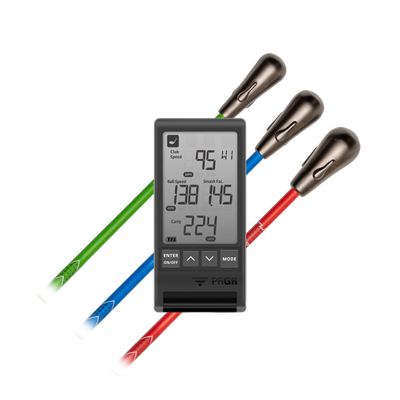
The SuperSpeed Golf system uses three training clubs: a light stick, a medium stick, and a heavy stick. Each one trains a different aspect of speed development.
The light stick is where you build peak velocity. You swing it as fast as you possibly can with no ball and no target, just maximum effort on every rep. The medium stick trains speed with slightly more control and begins building the connection between peak speed and real swing sequencing. The heavy stick develops explosive acceleration and builds the strength base that supports long-term speed gains.
One element of the protocol surprises most golfers: you train both your dominant and non-dominant side. This is not about becoming ambidextrous. Training your non-dominant side creates neurological balance that actually unlocks additional speed on your dominant side. It is one of the most important parts of the protocol, and one of the most commonly skipped.
A typical training session takes about 10 to 15 minutes. You train three times per week, not every day. Recovery between sessions is when the neurological adaptation actually happens. The protocol progresses through five levels, each building on the last. Most golfers start at Level 1 regardless of their current speed.
What Results Can You Realistically Expect?
Results vary by starting speed and consistency of training, but here is a realistic picture.
If you are currently swinging at 80 mph, a 5 to 8 percent gain adds 4 to 6 mph and roughly 12 to 18 yards of carry distance. At 95 mph, the same percentage gain adds 5 to 8 mph and 15 to 25 yards.
Most golfers notice their first speed improvements around weeks 2 to 3. The biggest jump typically comes between weeks 4 and 6. And once the neurological adaptation is established, the gains tend to be durable, as you keep 80 to 90 percent of what you build even if you reduce training frequency.
The biggest predictor of results is not starting speed or athleticism. It is compliance. Golfers who train three times a week, every week, for six weeks see the full gains. Those who train sporadically see partial results. The protocol itself is simple. The discipline is the variable.
How to Get Started
The Speed Sticks Pro are available at superspeedgolf.com and fit all ages and demographics. The free app that guides your protocol through all five levels is available on iOS and Android. A full training protocol guide is available at superspeedgolf.com/pages/swing-speed-training.
If you want a deeper background on the science and the different methods available, our guide to golf speed training covers the full picture.
Increasing swing speed in golf is not a fixed trait. It is a trainable skill with a proven method behind it. The research is solid, the results are consistent, and the investment of 10 to 15 minutes three times a week is modest relative to what you get back. The only question is whether you start.