
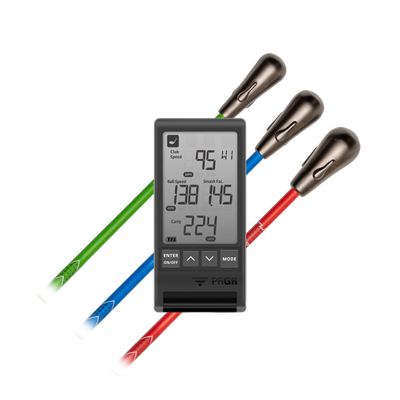


Yes, SuperSpeed Golf works, and the results are backed by both scientific principles and real-world data over the last 11 years.
Overspeed training has been shown to increase swing speed by 5–8% in as little as 4–8 weeks, often leading to 15–25 more yards off the tee when done consistently. (YouTube)
But to really understand why it works, and whether it will work for you, let's look at the science behind it and the results golfers actually see.
What Is Overspeed Training?
Overspeed training is a method used across multiple sports to increase speed by training the body to move faster than normal. Your brain remembers how fast your body usually moves when you make a golf swing. Overspeed training works by making your body move faster than normal during the training, gradually causing the brain to remember this faster speed.
With SuperSpeed Golf, this is done by swinging specifically weighted clubs, some lighter and some heavier than a standard driver, in a structured sequence from lightest to heaviest.
This approach forces your body to make the golf swing motor pattern move at speeds beyond its current baseline, which leads to long-term speed gains.
The Science: Why SuperSpeed Golf Works
The reason SuperSpeed works comes down to neuromuscular adaptation.
When you swing a lighter club, your body is able to move faster than normal. Over time, your brain begins to:
- increase motor unit recruitment
- improve sequencing and coordination
- remove built-in “speed limits” or governors on the brain
This process primarily trains your nervous system, not just your muscles.
As a result, your body begins to “remember” faster movement patterns and apply them to your normal swing.
Research and case studies show that this type of training can reset your baseline swing speed to a higher level over time. (MyGolfSpy)
Real Results: How Much Speed Can You Gain?
Most golfers using overspeed training programs like SuperSpeed can expect:
- +5 to +8 mph clubhead speed
- +15 to +25 yards driving distance
- noticeable improvements within 4–8 weeks
These gains come from training your body to move faster, not from changing your swing mechanics.
Even independent testing has shown measurable increases in clubhead speed after consistent training.
Dr. Tyler Standifird, professor of biomechanics at Utah Valley University, has conducted several studies on the effects of SuperSpeed training.
Ground Force Study
15 recreational golfers participated in a study measuring the changes in swing speed, ball speed, distance, and ground reaction force as a result of SuperSpeed training. Golfers' data was initially assessed using Trackman while players hit a series of drivers at max capacity, while force plates measured the golfer's force during the swing. Following initial testing, golfers were taught the Level 1 warm-up and training and were instructed to conduct 6 weeks of training. Final data was found using the same baseline testing methods.
- Club head speed increased by 5 MPH
- Ball speed increased by 11 MPH
- Carry distance increased roughly 22 yards
- Peak vertical on the lead leg during the downswing increased by 9.2%
On-Course Speed Training Study
On-course performance of ten recreational golfers was compared before and after a 6-week speed training program. Participants tracked rounds of golf using the Shot Scope V3 to measure distance and accuracy of all shots played over the course of about 4 weeks of playing. After completing this baseline assessment, players completed 6 weeks of the Level 1 SuperSpeed training program. Post-training measurements of on-course performance were evaluated and compared to the pre-training rounds.
- Swing speed increased by 6 mph
- Average and performance driving distance increased by nearly 15 yards
- Players increased fairway percentage from 41% to 51%
- Total scores improved by about 2.5 strokes
Junior Speed Study
9 junior golfers completed a 5-week speed training class to assess swing speed gains and distance potential. The participants ranged in age from 6 to 14 years old. Training in the class consisted of 30 minutes of a dynamic warm-up followed by the Level 1 SuperSpeed training protocol. Following this time, players would spend another 30 minutes working on driver swings with balls. Pre and post measurements were taken under the same conditions utilizing the PRGR radar.
- Swing speed increased by 8 mph
- Average yardage gain was 22.2 yards
- Highest driver speed increase was 15 mph
Senior Study
Ron Gring, top 100 GOLF instructor, conducted a SuperSpeed data collection on his senior students.
47 senior golfers participated in a study measuring swing speed changes as a result of SuperSpeed training. The average age was just over 70 years old, with the oldest being 89 years old. Speed measurements were taken over 4 months of training. Gains were separated out by female and male senior golfers.
- Average swing speed gain of over 5% for all players
- Female golfers on average gained 6%
- Male golfers on average gained 5%
- There were no differences for age and speed gains, all players gained speed regardless of age
MyGolfSpy Study
MyGolfSpy selected nine testers to try the SuperSpeed system. After the first six-week session, every tester experienced some level of improvement. They separated testers by starting speeds and put them into groups of “slow,” “mid,” and “high.” After completing two training protocols (roughly 12 to 14 weeks), the results from the testing pool pretty much mirrored SuperSpeed's stated expectations.
- Slow speed players improved by 8.8%
- Mid speed players improved by 7.6%
- High speed players improved by 5.5%
11 Years of In-House Data
For the last 11 years, in-house SuperSpeed data collections have shown similar results to these independent studies.
With the launch of the SuperSpeed Mobile App in 2025, SuperSpeed has been able to further validate these studies with larger numbers of users tracking their data.
In 2025, SuperSpeed app users saw on average a 4.8% increase in clubhead speed with their driver. Those who completed 25+ overspeed training sessions saw an average 10.7% increase in clubhead speed and an average gain of 11.1 mph with driver.
Why Speed Training Works Faster Than Traditional Methods
Most golfers try to gain distance through:
- swing changes
- strength training
- new equipment
While those can help, they are often slower and less direct.
Overspeed training works differently:
👉 It directly targets how fast you can move the club.
Instead of rebuilding your swing, it improves the speed ceiling of your current swing.
The “Speed Pyramid” Concept (Why Everything Builds on Speed)
Speed isn't just one thing — it's built from multiple components, including:
- ground force
- sequencing
- lag and energy transfer
- intent
SuperSpeed training primarily targets the top of the pyramid: maximum speed output.
As your speed increases, other parts of your swing often improve naturally. You learn to push and torque the ground more efficiently. You learn to sequence the parts of your body more effectively. You learn to maintain or create lag/downswing loading, then release that speed through impact. It is very hard to get faster by creating a worse golf swing.
How Long Does It Take to See Results?
Most golfers experience:
- Week 1–2: immediate speed spikes (often from intent and activation)
- Week 3–6: consistent gains begin to stick
- Week 6–8: measurable, repeatable increases
- Weeks 9+: gains continue with subsequent protocols
Speed gains are often non-linear, meaning breakthroughs come in jumps rather than steady increases. You might see little to no change in speeds for several sessions and then all of a sudden a big jump.
Do Gains Last?
After the first 5–6 weeks, the initial gains made typically last quite a while — even if the player stops the training.
SuperSpeed has built maintenance protocols that drop the training frequency down to 1 day per week. This is recommended to better maintain gains if you don't wish to continue to gain speed or train as intensely. This is often the case for those moving into the golf season or a heavy tournament schedule.
Does SuperSpeed Work for All Golfers?
SuperSpeed Golf works for:
- beginners looking for more distance
- mid-handicap players stuck at a plateau
- competitive players chasing maximum speed
- senior players who have lost speed
- juniors looking to take their speed to the next level
Because it trains the nervous system, it's effective across all skill levels.
When SuperSpeed Might NOT Work
Like any training system, results depend on consistency.
You may not see results if you:
- don't train regularly (2–3× per week recommended)
- don't swing with maximum intent
- stop after only a few sessions
Overspeed training is highly effective when applied consistently.
Do You Need a Launch Monitor or Radar?
No — but it helps.
Speed feedback tools can:
- track progress
- reinforce effort
- improve training efficiency
- provide feedback as to what swing cues produce results
However, many golfers still see strong results simply by following the protocols.
Final Verdict: Does SuperSpeed Golf Work?
Yes — SuperSpeed Golf is one of the most effective ways to increase swing speed and gain distance.
It works because it trains your body and brain to move faster, not because it changes your swing mechanics.
For golfers willing to train consistently, the potential gains in speed and distance make it one of the highest ROI training methods in the game.
👉 If your goal is more distance, overspeed training is one of the fastest ways to get there.